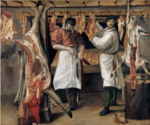
 The Kimball Art Museum portrays a side of the meat business not seen by many visitors to Forth Worth, Texas. If you only toured the Stockyards outside the Museum, you’d miss the preceding centuries of carnivorous history.
In the late 1580s, Annibale Carracci, painted two canvases that give us an idea of how meat fit into urban landscapes during Italy’s colorful Renaissance. By the late 16th century, Renaissance art entered the period of Mannerist painting leading to the Baroque period, when Read more [...]
The Kimball Art Museum portrays a side of the meat business not seen by many visitors to Forth Worth, Texas. If you only toured the Stockyards outside the Museum, you’d miss the preceding centuries of carnivorous history.
In the late 1580s, Annibale Carracci, painted two canvases that give us an idea of how meat fit into urban landscapes during Italy’s colorful Renaissance. By the late 16th century, Renaissance art entered the period of Mannerist painting leading to the Baroque period, when Read more [...] Meat, Indoors and Outdoors in Forth Worth
Reply
The Kimball Art Museum portrays a side of the meat business not seen by many visitors to Forth Worth, Texas. If you only toured the Stockyards outside the Museum, you’d miss the preceding centuries of carnivorous history.
In the late 1580s, Annibale Carracci, painted two canvases that give us an idea of how meat fit into urban landscapes during Italy’s colorful Renaissance. By the late 16th century, Renaissance art entered the period of Mannerist painting leading to the Baroque period, when Read more [...] 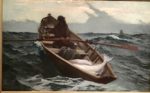 If you want a new experience while visiting an art museum, try going as a food logistics nerd. Watch the docents and visitor services personnel freeze for a moment as they try to comprehend your request for guidance on finding all the art in the museum that represents different aspects of the food supply chain and food logistics.
Recently, I had this pleasure at Boston’s Museum of Fine Arts, the home of such luminaries as John Singleton Copley and John Singer Sargent. The two ladies at the front
If you want a new experience while visiting an art museum, try going as a food logistics nerd. Watch the docents and visitor services personnel freeze for a moment as they try to comprehend your request for guidance on finding all the art in the museum that represents different aspects of the food supply chain and food logistics.
Recently, I had this pleasure at Boston’s Museum of Fine Arts, the home of such luminaries as John Singleton Copley and John Singer Sargent. The two ladies at the front  Not a day goes by when we aren't told how Big Food conspires to make us fat while exploiting our environment. Is this really the end of our debate about the state of our food system? Tyler Cowen's book, An Economist Gets Lunch (2012), offers an alternative view, one that might spread the blame rather than give us all a pass. He suggests that regulation, television, war, and changing demographics in the 20th century shaped a food system that looks industrial and often tasteless --- and in some cases
  Logi, a mythological Nordic warrior, won an medieval eating contest that involved consuming a tray of meat, bones, and the tray itself. (The tray was made of bread in those days, so not such a big deal as it appears.) His gluttonous display was typical of how men proved they were, indeed, men. The more food consumed, the more powerful the man.
For centuries now, eating enormous quantities of food has been necessary to maintain one’s social status among the elite as much as it was
Logi, a mythological Nordic warrior, won an medieval eating contest that involved consuming a tray of meat, bones, and the tray itself. (The tray was made of bread in those days, so not such a big deal as it appears.) His gluttonous display was typical of how men proved they were, indeed, men. The more food consumed, the more powerful the man.
For centuries now, eating enormous quantities of food has been necessary to maintain one’s social status among the elite as much as it was 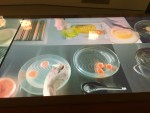 While “thought leaders” gather around the world to predict the future of food, Italians are hosting this year’s world’s fair, the Milan Expo 2015. The Italians are using the Expo to burnish its brand as the preeminent leader of food innovation. The Italians came up with the Maserati and the Moka pot, so why not edible packaging and digital delivery of food?
But wait, what happened to French leadership in all things food-related? If you attend the Milan Expo, you’ll be hard pressed
While “thought leaders” gather around the world to predict the future of food, Italians are hosting this year’s world’s fair, the Milan Expo 2015. The Italians are using the Expo to burnish its brand as the preeminent leader of food innovation. The Italians came up with the Maserati and the Moka pot, so why not edible packaging and digital delivery of food?
But wait, what happened to French leadership in all things food-related? If you attend the Milan Expo, you’ll be hard pressed  What does a remote Norwegian island 800 miles from the North Pole have to do with our food supply? Much more than you may think. Dr. Cary Fowler, speaking at the American Livestock Breeds Conservancy’s (ALBC) Annual Conference last week in Austin, Texas, explained how the Svalbard Global Seed Vault will protect global crop diversity for the next few millennia. Rarely covered by media and or included in the public debate about our food system, these genetics preservationists are vital to the sustainability
  A colleague of mine at UT invited me to peer into some locked bookshelves located in a conference room in the School of Human Ecology. The bookshelves, hidden from view by wood cabinets that line the perimeter of the room contain stacks of books, musty, and neglected for decades since the school renamed. During the 1980s, university administrators who were flummoxed by feminists scuttled Home Economics departments.
Within the wooden cabinets are stacks of books and magazines that once stood proudly
A colleague of mine at UT invited me to peer into some locked bookshelves located in a conference room in the School of Human Ecology. The bookshelves, hidden from view by wood cabinets that line the perimeter of the room contain stacks of books, musty, and neglected for decades since the school renamed. During the 1980s, university administrators who were flummoxed by feminists scuttled Home Economics departments.
Within the wooden cabinets are stacks of books and magazines that once stood proudly  In 1859, The Curiosities of Food was published in London by Peter Lund Simmonds. Simmonds joined other Londoners at that time, such as George Dodd, author of The Food of London, in a quest to understand food at home and abroad. By then, four hundred million people had been added to the British Empire, each nation bringing a food culture that seemed exotic to the ordinary Victorian. Simmonds wrote the first truly global account of food, one that reflected a fascination with all things foreign.
Following
In 1859, The Curiosities of Food was published in London by Peter Lund Simmonds. Simmonds joined other Londoners at that time, such as George Dodd, author of The Food of London, in a quest to understand food at home and abroad. By then, four hundred million people had been added to the British Empire, each nation bringing a food culture that seemed exotic to the ordinary Victorian. Simmonds wrote the first truly global account of food, one that reflected a fascination with all things foreign.
Following