 While the world watches Syria cross red lines, Syrians contend with breadlines. Hardly a grenade passes through rebel or military hands without making an impact upon the country’s food supply. Collateral damage inflicted on crops and animals rarely reaches consumers of news about the Syrian crisis.
Throughout history, governments have recognized the link between war, food, and national security. The Romans noticed the connection when they sought food sources throughout their empire; the French Read more [...]
While the world watches Syria cross red lines, Syrians contend with breadlines. Hardly a grenade passes through rebel or military hands without making an impact upon the country’s food supply. Collateral damage inflicted on crops and animals rarely reaches consumers of news about the Syrian crisis.
Throughout history, governments have recognized the link between war, food, and national security. The Romans noticed the connection when they sought food sources throughout their empire; the French Read more [...] Marching On Empty Stomachs
Reply
While the world watches Syria cross red lines, Syrians contend with breadlines. Hardly a grenade passes through rebel or military hands without making an impact upon the country’s food supply. Collateral damage inflicted on crops and animals rarely reaches consumers of news about the Syrian crisis.
Throughout history, governments have recognized the link between war, food, and national security. The Romans noticed the connection when they sought food sources throughout their empire; the French Read more [...] 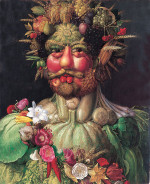 The Blanton Museum in Austin, Texas, is now showing Sam Taylor-Wood’s 2001“Still Life,” a three-minute video of fruit on a plate, rotting. The time-lapse images are transfixing, engaging your senses as you watch fruit decompose, moment by moment. (http://www.youtube.com/watch?v=BJQYSPFo7hk)
Food and art have enjoyed each other’s company for centuries. Rudolf Arcimboldo’s 16th century painting, “A Feast for the Eyes,” is an classic art/food mashup. (http://media.smithsonianmag.com/images/Arcimboldo-Rudolf-II-631.jpg.)
Food
The Blanton Museum in Austin, Texas, is now showing Sam Taylor-Wood’s 2001“Still Life,” a three-minute video of fruit on a plate, rotting. The time-lapse images are transfixing, engaging your senses as you watch fruit decompose, moment by moment. (http://www.youtube.com/watch?v=BJQYSPFo7hk)
Food and art have enjoyed each other’s company for centuries. Rudolf Arcimboldo’s 16th century painting, “A Feast for the Eyes,” is an classic art/food mashup. (http://media.smithsonianmag.com/images/Arcimboldo-Rudolf-II-631.jpg.)
Food  In today’s noisy, scrappy conversation about food, a pitch-perfect note once in a while bubbles to the top. Bee Wilson, a food historian and author, recently brought us one of those sparkling notes in her review of William Sitwell’s new book, A History of Food in 100 Recipes. Wilson writes reviews in The New Yorker and sometimes her own books, such as Consider The Fork, published by Basic Books in 2012.
While offering her thoughts on Sitwell’s attempt to extract historical narratives from
In today’s noisy, scrappy conversation about food, a pitch-perfect note once in a while bubbles to the top. Bee Wilson, a food historian and author, recently brought us one of those sparkling notes in her review of William Sitwell’s new book, A History of Food in 100 Recipes. Wilson writes reviews in The New Yorker and sometimes her own books, such as Consider The Fork, published by Basic Books in 2012.
While offering her thoughts on Sitwell’s attempt to extract historical narratives from 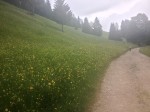 Yes, just spent a week logging miles upward and downward. After a week in Paris, I joined my family for a week-long adventure in Bohemia, in Grainau, where the alps gather around the border between Germany and Austria. Three of us competed in the Zugspitz Ultratrail Race set in the shadow of the tallest alp in Germany. I ran 25 miles and my two children each ran 42. But the kicker was the 9,000 feet up and 9,000 down for the kids and 6,000 feet up/down for my distance. In the rain, and fog, and over
  My last post about the early years of food on TV brought back memories of those days of easy pleasures created by the mere presence of a TV in your home. In our house, the small black and white television sat near the kitchen and afterschool we gathered round to watch Engineer Bill drink milk in between cartoons that he ran with his program, Cartoon Express.
William Stulla, AKA, Engineer Bill, began his program in 1954 and rolled into living rooms at 6:30 in Southern California, when I was six
My last post about the early years of food on TV brought back memories of those days of easy pleasures created by the mere presence of a TV in your home. In our house, the small black and white television sat near the kitchen and afterschool we gathered round to watch Engineer Bill drink milk in between cartoons that he ran with his program, Cartoon Express.
William Stulla, AKA, Engineer Bill, began his program in 1954 and rolled into living rooms at 6:30 in Southern California, when I was six 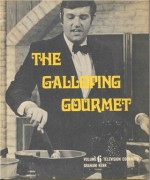 Graham Kerr. The Galloping Gourmet. The man and his brand are inseparable for most of us who got a taste of food programs on TV during the 1960s. Mr. Kerr first appeared on what was known as “experimental TV” on April 16, 1960, before the acclaimed Julia Child made her debut as The French Chef in 1963. But even before the two appeared on TV, Marcel Boulestin, a French chef living in England, appeared on the experimental television programs produced by the BBC during the 1930s. In January